PESTWRITERS
Helping Pest Control Businesses
Pest Control Jobs in Jacksonville (2026)
Pest control jobs in Jacksonville are increasing—but the headline number hides what is actually happening underneath.
This is not a simple growth market. It is a market being reshaped by two external pressures that are forcing employers to change how they hire:
- logistics-driven compliance requirements tied to port expansion
- accelerating termite risk across Northeast Florida
These forces are not adding generic jobs. They are redefining what a “qualified technician” looks like.
Jacksonville Is Not One Market Anymore
The most important shift in 2026 is structural: Jacksonville has split into two parallel job markets, each with different hiring criteria and career outcomes.
Compliance-Driven Commercial Work (Port and Logistics)
Expansion around Jacksonville Port Authority has created sustained demand for pest control services inside:
- distribution centers
- food storage facilities
- cold-chain logistics environments
These sites operate under regulatory frameworks such as the Food Safety Modernization Act.
That changes the job.
Technicians in these environments are expected to:
- maintain audit-ready records
- follow fixed service protocols
- use digital monitoring systems
- pass third-party inspections
This is not traditional route work. It is compliance work with operational accountability.
Employers hiring for these roles are not looking for general experience—they are looking for process reliability and documentation discipline.
Termite-Driven Specialist Work (Environmental Pressure)
At the same time, Jacksonville is dealing with a measurable increase in termite-related demand.
Research from University of Florida IFAS has confirmed the continued expansion of Formosan subterranean termites into Northeast Florida.
This has direct hiring consequences:
- more inspections tied to real estate transactions
- increased demand for termite bonds
- higher volume of treatment and retreat work
Unlike general pest control, termite work is:
- higher liability
- more technical
- directly tied to property value
This creates a second hiring track focused on:
- WDO inspectors
- termite technicians
- specialists trained in advanced treatment systems
Why This Split Is Where Most Candidates Get It Wrong
Most applicants approach Jacksonville as if it were a single, general labor market.
That assumption leads to slow progression.
The reality is:
- compliance roles require structure and documentation discipline
- termite roles require technical specialization and certification
Entry-level positions sit outside both tracks. Staying in that space too long limits earnings and progression.
This is why many technicians feel “stuck” after initial hiring—they never transition into one of the two high-value segments.
Salary Growth Is Concentrated, Not Universal
Pay in Jacksonville is increasing, but not evenly.
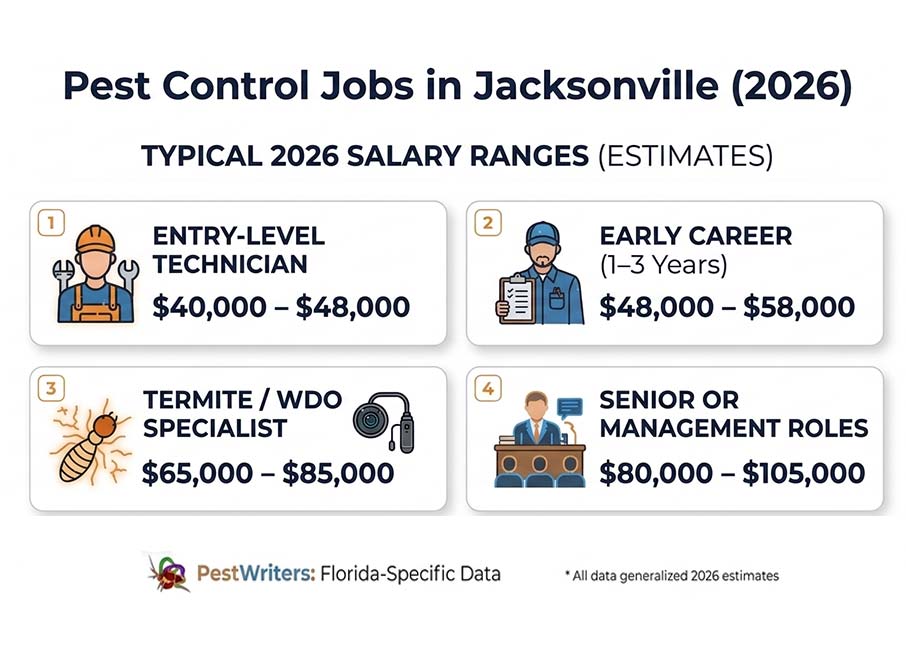
Typical 2026 ranges:
- Entry-level technician: $40,000 – $48,000
- Early career (1–3 years): $48,000 – $58,000
- Termite / WDO specialist: $65,000 – $85,000
- Senior or management roles: $80,000 – $105,000
Higher-end termite and fumigation roles can exceed these levels depending on contract value and commission structures.
According to the U.S. Bureau of Labor Statistics, the national median for pest control workers is roughly $43,000. Jacksonville exceeds this in specialist roles because demand is targeted, not broad.
The gap between generalist and specialist earnings continues to widen.
Learn more about WDO specialists by clicking here: Why WDO Technicians earn more in Florida
The Quiet Volume Driver: Construction and Pre-Treatments
While industrial and termite work drive high-value roles, residential construction drives job volume.
Florida regulations require soil pre-treatment before construction, ensuring:
- consistent demand for entry-level technicians
- steady route-based work
- ongoing service contracts
This segment supports hiring but has different characteristics:
- lower margins
- higher turnover
- limited long-term earnings without specialization
It is a starting point—not the destination.
What Employers Are Actually Screening For
Across both major hiring tracks, employers are filtering for the same underlying signals:
- progress toward licensing
- reliability in structured work
- ability to follow defined systems
Licensing is governed by the Florida Department of Agriculture and Consumer Services, and early movement toward certification is one of the strongest indicators of hireability.
The shift is simple but critical:
Employers are no longer hiring “workers”—they are selecting future licensed operators.
Where Candidates Are Rejected (Before Interviews)
In Jacksonville, rejection often happens early and quietly.
Common failure points include:
- no visible licensing intent
- lack of understanding of compliance environments
- inconsistent work history in field roles
- weak communication during initial contact
Employers are not evaluating only current ability—they are assessing whether a candidate can move into higher-value roles within a defined timeframe.
The Role of Real Employers in Shaping the Market
Large operators such as Terminix, Orkin, and Rentokil continue to hire across Jacksonville.
Their hiring models reinforce current trends:
- structured routes
- performance tracking
- clear pathways into licensed roles
At the same time, regional and independent firms are expanding in:
- residential service routes
- termite-focused operations
- niche services such as mosquito control
This mix creates opportunity—but also inconsistency in training quality and expectations.
Why Jacksonville Is Different from Other Cities
Compared to Houston, Jacksonville is not broader—it is more concentrated.
Houston offers multiple parallel demand drivers across industries.
Jacksonville is defined by:
- logistics infrastructure
- termite-driven environmental pressure
This creates a market where:
- specialization happens faster
- entry-level roles transition more quickly
- high-value positions are easier to access—but harder to qualify for
What This Means for Entering the Market
A general approach to job searching is inefficient in Jacksonville.
A more effective strategy is:
- identify whether to pursue compliance or termite work
- begin licensing early
- target roles aligned with that direction
This reduces time spent in low-value positions and increases the likelihood of progression into higher-paying roles.
For broader regional comparisons and salary benchmarks, see:
https://pestwriters.com/pest-control-jobs-in-florida-and-texas-salaries-and-hiring-2026/
FAQs About Pest Control Jobs in Jacksonville
Is Jacksonville a strong market for pest control jobs?
Yes—but demand is concentrated in specific technical roles rather than evenly distributed.
Do I need experience to get hired?
No, but employers expect clear movement toward licensing and specialization.
What is the fastest way to increase earnings?
Move into termite (WDO) or compliance-driven commercial roles.
Is pest control work seasonal in Jacksonville?
No. Demand remains consistent due to climate and infrastructure-driven activity.
Where the Jacksonville Market Is Headed
The Jacksonville pest control job market in 2026 is not defined by simple growth.
It is defined by pressure—from infrastructure expansion and environmental risk.
That pressure is reshaping hiring into two clear paths:
- compliance-driven commercial work
- termite-driven specialist roles
Entry-level jobs still exist, but they are no longer where long-term value sits.
Technicians who recognize this shift early—and move toward specialization—are the ones who benefit from Jacksonville’s evolving market.
